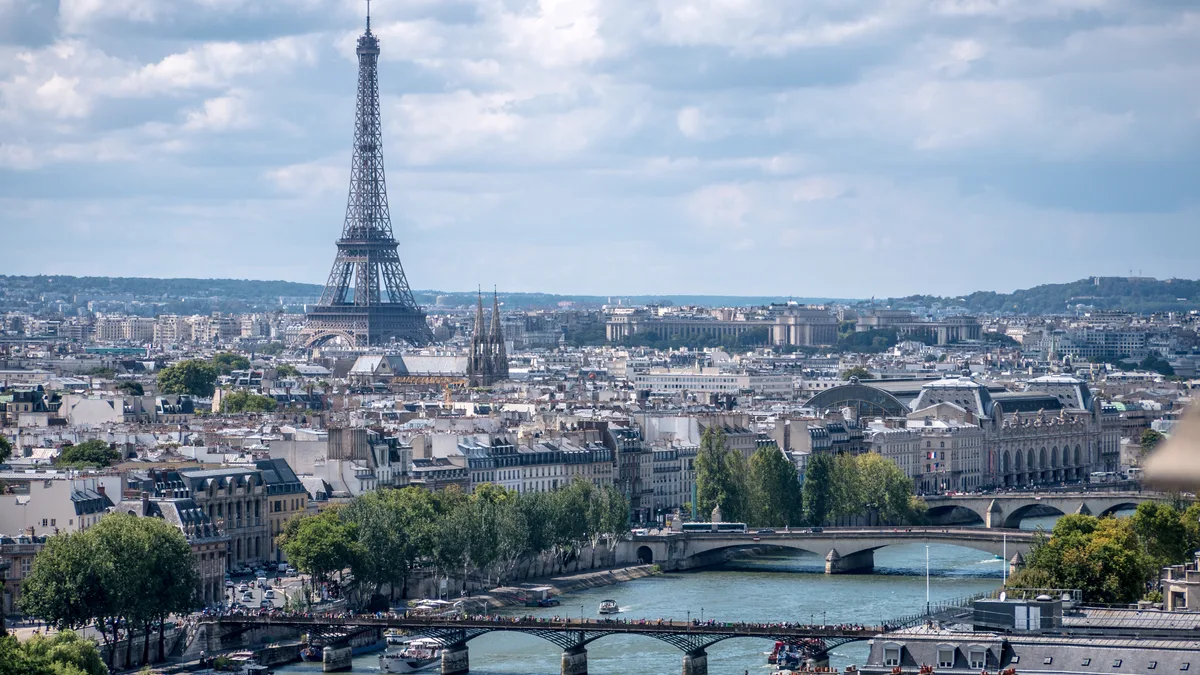
Paris
| Country of origin | France |
|---|---|
| First created | 1920s |
| Original use | Luxury ready-to-wear for women |
| Closure | Zip and hook-and-eye |
| Fabric | Often silk, wool, or cotton blends |
| Pockets | Two side seam pockets |
| Hem | Straight or slightly flared |
Origin and history
Paris originates as a settlement on the Île de la Cité in what is now France, with its founding traced to the Parisii, a Celtic tribe, in the 3rd century BC. The city became a significant Roman administrative center known as Lutetia following the Roman conquest in the 1st century BC. Its medieval history was shaped by the rise of the Capetian dynasty, which established Paris as the permanent capital of the Kingdom of France in the late 10th century. The city underwent massive transformation in the mid-19th century under Baron Haussmann, who directed the creation of its characteristic wide boulevards and uniform architectural style. Paris solidified its role as a global center for art, philosophy, and politics during the Enlightenment and subsequent centuries. Its modern identity has been continually forged through events like the French Revolution, the Belle Époque, and its status as a 20th-century cultural capital.
What it is for
Paris functions as the political and administrative capital of France, housing the nation's primary government institutions, including the Presidency, Parliament, and key ministries. It serves as a major global hub for finance, commerce, and business, hosting the headquarters of numerous multinational corporations and financial exchanges. The city is a preeminent center for education and research, with a high concentration of universities, Grandes Écoles, and scientific research institutions. It acts as a central node for transportation within France and Europe, featuring major international airports, railway stations, and a comprehensive metropolitan rail network. Paris provides a permanent setting for countless cultural and historical institutions, including museums, libraries, archives, and performance venues. The city's infrastructure and amenities support a large residential population while accommodating millions of annual visitors for both tourism and professional purposes.
Overview
Paris is administratively divided into 20 arrondissements, arranged in a clockwise spiral from the center, each with its own distinct character and local government. The city's geography is defined by the River Seine, which flows through its center and is crossed by numerous iconic bridges. Its architectural landscape is a palimpsest of periods, from medieval structures like Notre-Dame to modernist developments like La Défense business district. The Parisian economy is diversified, with strong sectors in tourism, luxury goods, publishing, fashion, and professional services. Public space is organized around famous landmarks, extensive park systems like the Bois de Boulogne, and formal gardens such as the Tuileries. The metropolitan area, known as Île-de-France, is the largest urban economy in France and one of the most significant in Europe.
What to know
The legal and administrative entity of Paris has the status of both a commune and a department, with a single council governing both functions. The city operates on a centralised radial model, with major ring roads and orbital railways defining its expansion and connectivity. Parisian housing is characterized by a predominance of mid-rise, limestone-faced apartment buildings, with a historically tight and expensive real estate market. Key annual events that structure the city's calendar include Paris Fashion Week, the French Open tennis tournament at Roland-Garros, and the finish of the Tour de France cycling race. The city's public transport system, run by the RATP, integrates the Metro, buses, trams, and the RER commuter rail network, all operating on a unified fare system. Understanding the distinction between the City of Paris proper and the larger Île-de-France region is crucial for grasping its scale, governance, and infrastructure planning.
Common questions
A common question concerns the best time to visit, with many events clustered in the spring and fall fashion weeks, trade fairs, and cultural seasons, while August sees many local businesses close. Visitors often ask about navigating the arrondissement numbering system, which is essential for locating addresses and understanding the social and commercial geography. Questions frequently arise about the accessibility and operation of major museums and monuments, many of which require advance booking and have specific weekly closure days. Many inquire about the practicalities of the public transportation system, particularly the differences between the Metro, the RER, and bus networks, and the types of tickets required. There is consistent interest in the seasonal offerings, such as Christmas markets, summer riverside beaches (Paris Plages), and seasonal sales periods which are legally mandated. People regularly seek clarification on the linguistic expectations, asking whether English is widely spoken in tourist and business sectors, which varies significantly by arrondissement and context.
Pros and cons
The city benefits from an exceptionally dense and efficient public transportation network that makes car ownership unnecessary for most residents and visitors. A notable drawback is the very high cost of living, particularly for housing, which places a severe financial strain on middle-income residents and can limit residential mobility. The popularity of Paris as a tourist destination leads to intense crowding at major sites, congested public transport during peak seasons, and a sense of commodification in central districts. The bureaucratic processes for administrative tasks, from residency permits to business registration, are often cited as complex, slow, and inflexible. A common mistake is underestimating the scale and pace of the metropolitan area, treating only the central tourist arrondissements as representative of the city's diverse and often more residential outer neighborhoods.
Who it suits
Paris suits professionals in industries like finance, fashion, diplomacy, academia, and the arts, where the city's status as a global node provides critical networking and career opportunities. It is well-suited for students and researchers attracted by the concentration of prestigious universities, libraries, and specialized institutions offering a wide range of academic programs. The city appeals to individuals with a deep interest in history, art, and architecture who will appreciate daily access to museums, historical walks, and a richly layered urban fabric. It is a match for those who prioritize a car-free lifestyle and rely on robust public transit, walking, and cycling for daily mobility across a dense urban environment. Paris suits people comfortable with a fast-paced, formal, and sometimes impersonal urban social environment, where anonymity is easy but building local community can require concerted effort. It is less suited for those seeking a low-cost living situation, abundant private green space, or a consistently relaxed and informal atmosphere in their immediate neighborhood.
Latest Paris news
Latest reporting

Haus Labs Taps Emily in Paris Star for Concealer Campaign
Lady Gaga's Haus Labs features actress Philippine Leroy-Beaulieu, 63, in its new 'We Love Concealer' campaign to celebrate beauty at every age.

Bérangère Fromont's République Portrays
Photographer Bérangère Fromont's new book and exhibition, République, presents elegant portraits of the young skateboarders at Paris's Place de la...

L’Oréal Paris Names Kristen Bell as Global Ambassador
L’Oréal Paris has appointed American actress Kristen Bell as its new Global Ambassador, who will front the brand's upcoming Age Perfect Cell Renewal...