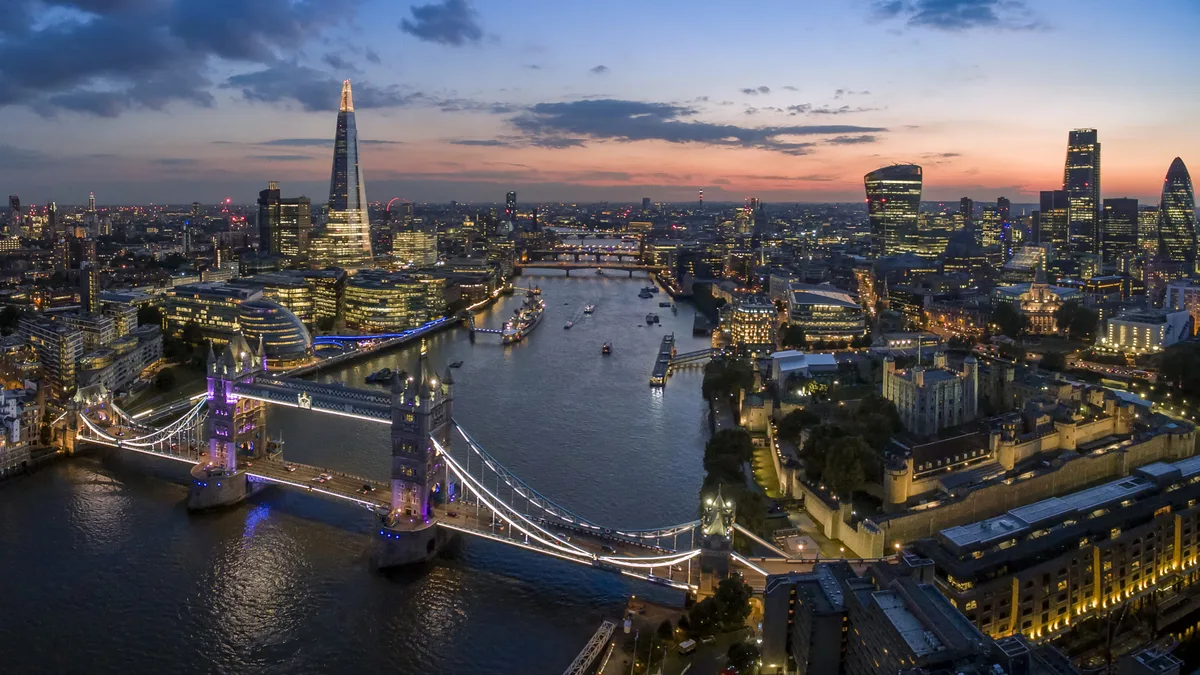
London
| Season of the year | Autumn |
|---|---|
| Typical start date | Late September |
| Typical end date | Early December |
| Key fashion weeks | London Fashion Week |
| Associated cultural events | Frieze London, London Film Festival |
| Notable retail event | Black Friday |
| Primary weather characteristic | Cool and damp |
| Daylight characteristic | Decreasing daylight hours |
Origin and history
London's origins lie in a settlement established by the Romans following their invasion of Britain in AD 43. This initial fortified port, known as Londinium, was founded on the north bank of the River Thames, a strategic location for trade and military control. The city survived its near-destruction during the Boudican revolt in AD 60/61 and grew to become the capital of the Roman province of Britannia. Following the Roman withdrawal in the 5th century, the Saxon settlement of Lundenwic developed slightly to the west, remaining a significant trading centre. The Norman Conquest in 1066 solidified London's political and economic dominance, with William the Conqueror building the Tower of London to assert his authority. Its continuous history as a major population centre, financial hub, and political capital spans over two millennia, evolving from its Roman roots through medieval, Tudor, Georgian, Victorian, and modern eras.
What it is for
London functions as the political capital of the United Kingdom, housing the seats of government in Westminster, including Parliament and the monarch's official residence, Buckingham Palace. It serves as a pre-eminent global financial centre, with the City of London and Canary Wharf being central nodes for banking, insurance, and professional services. The city is a primary hub for culture and the arts, containing major national museums, galleries, theatres, and orchestras that both preserve heritage and generate new work. It acts as a critical international transport nexus, with Heathrow Airport being one of the world's busiest and its rail networks connecting the UK and continental Europe. London is also a leading centre for higher education and research, hosting numerous universities and academic institutions of global repute. Furthermore, it provides the infrastructure and venues for large-scale national events, state ceremonies, and international sporting competitions.
Overview
London is not a single administrative entity but a vast metropolitan region composed of 32 boroughs and the historic City of London, governed by the Greater London Authority. Its geography is fundamentally defined by the River Thames, which flows eastward through the city, historically dividing the more commercial north from the traditionally residential south. The urban landscape is an immense patchwork of distinct villages and districts, each with its own character, from the financial skyscrapers of the City to the residential squares of Kensington and the creative hubs of East London. Its architecture presents a visible chronology of history, featuring Roman walls, medieval churches, Georgian terraces, Victorian engineering, and modern glass towers. The city's public transport system, primarily the London Underground, is an extensive network essential for daily movement across its sprawling area. Demographically, London is one of the most diverse cities globally, with a population representing a vast array of languages, cultures, and communities.
What to know
The London Underground, commonly called the Tube, is the oldest metro system in the world, with its first line opening in 1863, and requires an understanding of its zoning system for fare calculation. London's climate is temperate maritime, characterised by generally mild winters, cool summers, and rainfall distributed throughout the year, with weather conditions often changing rapidly. The city operates on Greenwich Mean Time (GMT) during winter and British Summer Time (BST), which is GMT+1, from late March to late October. While English is the primary language, over 300 languages are spoken, and the city's cultural norms reflect a blend of British formality and cosmopolitan informality. Legal driving is on the left-hand side of the road, and the central Congestion Charge zone requires a daily fee for most vehicles entering during weekdays. The city uses the British Pound Sterling (£), and while contactless payment is ubiquitous for transport and shopping, some smaller markets or vendors may prefer cash.
Common questions
A common question concerns the difference between London and the City of London, the latter being a tiny historic and financial district governed separately from the rest of Greater London. Visitors frequently ask about the best way to visit the royal palaces, with Buckingham Palace's Changing of the Guard being a popular but crowded ceremony with a variable schedule. Many inquire about the necessity of tipping, which is customary but not mandatory, typically around 10-12.5% in restaurants if service is not included, while taxi drivers may expect a small rounding up of the fare. People often question the value of travel cards versus contactless payment on transport, with contactless payment almost always providing the best daily cap and convenience. There is frequent confusion over the legal drinking age, which is 18, and the requirement for proof of age identification, which is strictly enforced in most venues. Another regular enquiry involves the availability of public access to historic legal institutions like the Old Bailey or the Royal Courts of Justice, which is often limited but sometimes possible.
Pros and cons
The extensive, integrated public transport network, while busy, enables efficient movement across a very large urban area without the need for a private car. The sheer scale of economic and professional opportunity across finance, tech, creative industries, and academia draws global talent and facilitates career development. Major drawbacks include the extremely high cost of living, particularly for housing and rental prices, which can consume a disproportionate share of income and force long commutes. The city's popularity leads to intense crowding on transport, in public spaces, and at major attractions, which many find overwhelming and stressful over the long term. A common mistake is underestimating the city's physical size and the time required to travel between districts, leading to inefficient scheduling and exhaustion.
Who it suits
London suits ambitious professionals and graduates seeking rapid career advancement in sectors like finance, law, technology, and the arts, where the concentration of headquarters and networks is unmatched. It is ideal for students attending its many universities who value access to vast academic resources, diverse social scenes, and potential internship opportunities alongside their studies. The city appeals to culture enthusiasts who wish to immerse themselves in a constant, world-leading rotation of theatre, music, exhibitions, and culinary scenes from every global region. It is less suited to individuals seeking a quiet, slow-paced lifestyle or those who are uncomfortable with constant urban stimulus, anonymity, and a relative lack of personal space. London can work well for families who can secure accommodation near good schools and parks, but the high costs and logistical challenges are significant barriers. It is particularly well-matched for people who thrive on diversity and change, valuing exposure to international communities and the dynamic energy of a global metropolis.
Latest London news
Latest reporting

Kiehl's Opens European Flagship on London's Carnaby Street
Kiehl's has opened its second standalone West End boutique and European flagship store at 43 Carnaby Street. The 1,300 sq ft, two-floor location...

H&M and SHOWstudio Debut Interactive Tech at AW26 Show
H&M partnered with Nick Knight's SHOWstudio for an Autumn/Winter 2026 London Fashion Week show titled 'H&M&YOU&I'.

London Fashion Week SS27 Off-Schedule Shows Announced
Dazed details six independent designer presentations happening outside the official BFC calendar for London Fashion Week SS27, including debuts from...

Trinny London, 111SKIN, Paula's Choice, Glow Recipe Launch
Trinny London debuts a 30-shade skin tint, 111SKIN launches an at-home chemical peel, Paula's Choice releases a peptide moisturizer with Hannah...

Top Stylists Reveal 17 Fall Haircut Trends for 2026
Hairstylists from London to New York detail the haircut trends set to dominate the fall 2026 season, including updated bobs, shags, and pixies.

Jo Malone London debuts WildWash dog shampoo
Jo Malone London has entered the pet grooming market with a permanent Orange & Cedarwood Dog Shampoo, created in partnership with British brand...